The Humble Cup
A history of coffee and tea, and what a five-dollar cup says about saving, spending and the good life
By Kenneth McDonald

Coffee, tea and cake on one table.
Follow the route
The paths coffee and tea travelled, with the dates this essay can source. Colombia is marked in gold. Tap a button to switch between them.
Swipe the map sideways to move across it.
- 1Ethiopian plateau
Coffee plants grew wild here. The goatherd Kaldi, said to have found coffee in the ninth century, is a legend.
- 2Yemen and the port of Mocha
Coffee was grown here by the 15th century, and Yemen supplied the world's coffee until the close of the 17th century.
- 3Mecca
Coffee was established here by 1511, when religious scholars issued a polemic against it.
- 4Istanbul
Coffeehouses spread in the 16th century. In 1623 Sultan Murad IV ordered them torn down.
- 5Venice
Prospero Alpini described and illustrated the coffee bush in a book printed here in 1592. Caffè Florian opened in 1720.
- 6Amsterdam
In 1714 the mayor of Amsterdam gave a young coffee tree to King Louis XIV of France.
- 7London
Pasqua Rosée opened the first London coffee house in 1652. Lloyd's Coffee House was first named in 1688.
- 8Java
The Dutch East India Company established a coffee plantation here in 1699.
- 9Martinique
In 1723 Gabriel de Clieu carried a coffee seedling here.
- 10Brazil
Seeds from French Guiana began coffee here in the 18th century. Slavery was abolished on 13 May 1888.
- 11Saint-Domingue, now Haiti
By 1788 France's colonies, above all this one, produced two-thirds of the world's coffee, grown by enslaved Africans.
- 12Colombia
Coffee arrived in the 18th century, and the first recorded exports left Cúcuta in 1835. The growers' federation was founded on 27 June 1927, and UNESCO inscribed the Coffee Cultural Landscape in 2011. Third-largest producer in the world.
- 1South-west China
Part of the hill country where the tea plant is native. In Chinese tradition the emperor Shennong tasted the first tea in about 2700 BCE, a legend.
- 2Xi'an, China
Tea buds were found in the tomb of Emperor Jing (188–141 BCE), reported in 2016.
- 3Kyoto and Japan
Monks brought tea seeds in the early 9th century, Eisai brought seeds in 1191, and sencha was developed near Kyoto in 1738.
- 4Macau
Portugal had a trading port here by 1557.
- 5Amsterdam
Dutch East India Company ships carried tea to Europe in the 17th century.
- 6London
Tea arrived in the 1650s, became fashionable after 1662, and the East India Company placed its first order in 1664.
- 7Assam, India
The first Assam tea was sent to England in May 1838 and sold at auction in London.
- 8Sri Lanka
James Taylor planted 19 acres of tea at Loolecondera in 1867.
- 9Kenya
Kenya produced 598.47 million kilograms of tea in 2024, according to the Tea Board of Kenya.
A cup of coffee has been accused of being the reason a person is not rich. The charge is short and the sum is correct: a purchase of 5 every day, in dollars, pounds or Australian dollars, costs 1,825 over a year. David Bach, the author of The Automatic Millionaire, gave the charge its best-known name, the Latte Factor, and the Consumer News and Business Channel (CNBC) reported on 19 October 2018 that Bach holds that small regular purchases, such as a $5 daily latte, add up to a large sum and are better redirected into savings, where compound interest can work on them.
The cup has a defence, and it begins a long way from any café counter. It starts with wild plants on a plateau in Ethiopia and a leaf buried with a Chinese emperor, and it runs through the Sufi communities of Yemen, a Venetian botanist's book, a London coffeehouse where ships were insured, and the steep coffee hillsides of Colombia. This essay follows that defence from the beginning, tests the accusation against official records, and then sits two sensible people at one table, one who wants to save the 1,825 and one who wants to spend it on the pleasure of a cup, because each of them is right about something.
The accusation, tested
The book The Money Shelf put this claim, along with 21 others, against the official household spending records of the United States, the United Kingdom and Australia. The arithmetic of the claim holds, and the records show that the cup is a small part of a household budget.
In the United States, the Bureau of Labor Statistics Consumer Expenditure Survey for 2024, released on 19 December 2025, puts average spending at $78,535 per consumer unit, and a daily 5 is 2.3 per cent of that. Housing and transport together take 50.4 per cent. In the United Kingdom, the Office for National Statistics figures for the financial year ending 2025, released on 11 June 2026, show the same daily 5 as 5.2 per cent of average spending, while housing and transport take 31.7 per cent. In Australia, the Australian Bureau of Statistics Household Expenditure Survey for 2015–16, the latest survey of household spending, puts the daily 5 at 2.5 per cent, against 34.1 per cent for housing and transport.
The book gave the claim the verdict weak diagnosis, which means that the arithmetic is true and explains less than the claim says it does. The sum is right, and the larger sums are somewhere else. The writer Donella Meadows, reviewing Your Money or Your Life by Vicki Robin and Joe Dominguez in 1993, described readers who track every penny to find the things they buy and never use, which the book calls its "gazingus pins". A cup of coffee has the advantage over a gazingus pin that it is finished within about twenty minutes and nobody has to find a drawer for it.
A bean from the highlands
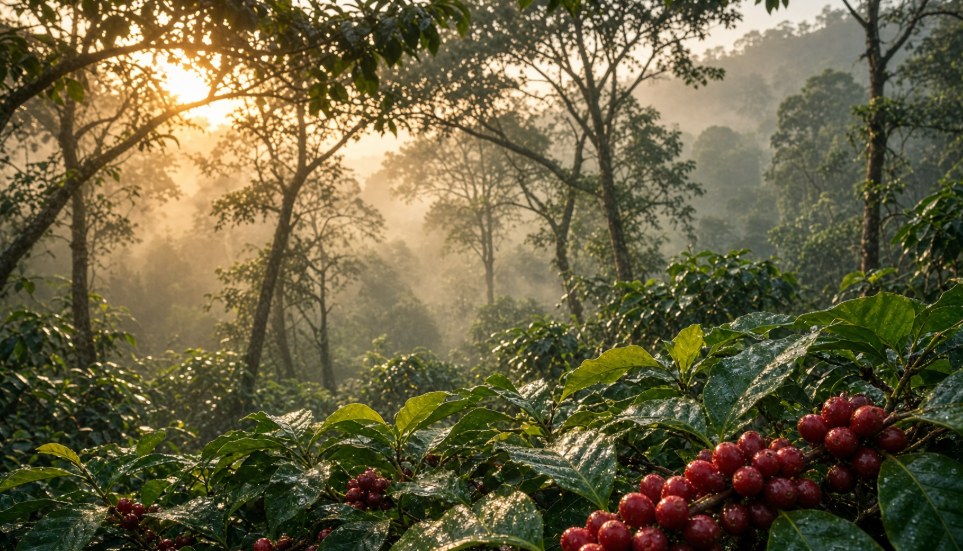
Coffee plants grew wild on the Ethiopian plateau. The famous story of the goatherd Kaldi, who is said to have noticed his goats growing lively after eating the red berries in the ninth century, is told by the Encyclopaedia Britannica and the National Coffee Association of the United States as a legend, and both present it that way.
The documented story begins later. By the fifteenth century coffee was being grown in what is now Yemen, where tradition holds that Sufi communities drank it to stay awake for prayers at night. Yemen supplied the world's coffee until the close of the seventeenth century, and much of it left through the port of Mocha, whose name is still on café menus today.
Coffee was argued over almost from the start. By 1511 the drink was established in Mecca, and in that same year religious scholars there issued a polemic against it, as the Center for World History at the University of California, Santa Cruz, records in its history of coffee. Some judged the drink intoxicating, and many people drank it anyway.
The house where the news was sold
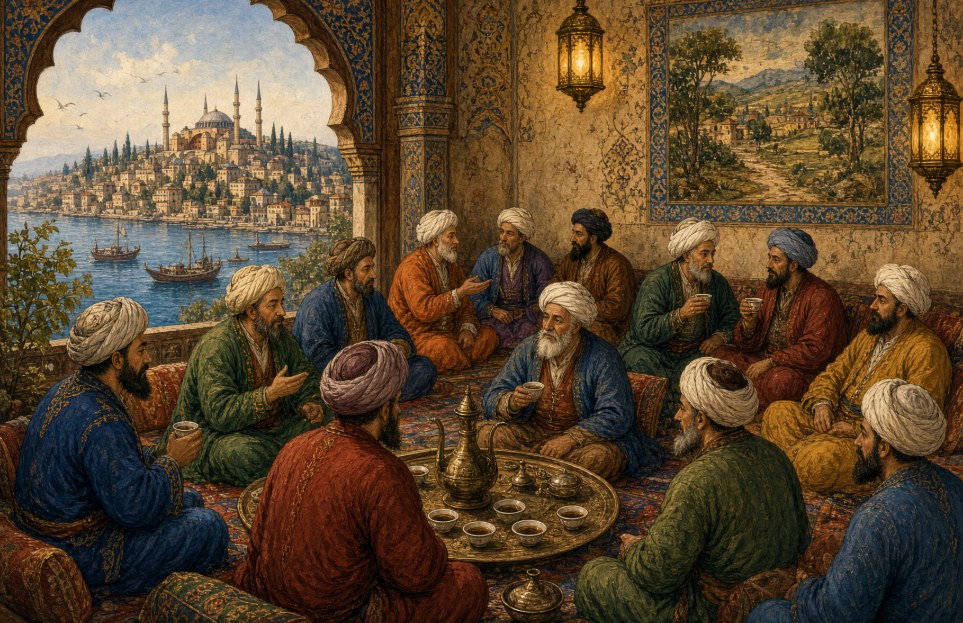
The coffeehouse is the part of the story that leads most directly to the modern café. Coffeehouses, called qahveh khaneh, spread across Iran, Egypt, Syria and Turkey in the sixteenth century, and in them, as the National Coffee Association of the United States describes, people could listen to music, watch performances, play chess and keep up with the news. Rulers sometimes tried to close them: in 1623 Sultan Murad IV ordered the coffeehouses of Istanbul torn down, and they stayed shut through his reign.
The drink then moved west. The Venetian botanist Prospero Alpini, who had travelled to Egypt, became the first European writer to describe and illustrate the coffee bush, in his book De plantis Aegypti, printed in Venice in 1592. Venice traded with the Ottoman Empire, and by the end of the seventeenth century Venice had its first coffee house on Piazza San Marco, and in 1720 Caffè Florian opened there, as Italy's national tourism board records, and it still serves coffee today.
In London, a plaque in St Michael's Alley marks the spot: "Here stood the first London coffee house at the sign of the Pasqua Rosee's Head, 1652." Pasqua Rosée had come to London from Smyrna, in the Ottoman Empire. One of the coffeehouses that followed, Edward Lloyd's Coffee House in Tower Street, was named for the first time in the London Gazette in 1688, when London had more than 80 coffeehouses. It specialised in shipping news and was popular with ship owners and captains, and businessmen rented its tables, which were called boxes, to sell insurance to ship owners in case a ship did not return. In 1691 it moved to 16 Lombard Street, which became the place for marine underwriting by individuals, and Lloyd's of London describes this as its beginning.
A coffee can look like only an expense, yet one of the world's great insurance markets grew out of a room where people bought a drink and stayed to talk about ships.
A leaf from the hills

Tea has a longer written history and a shorter list of legends that can be trusted. The tea plant is thought to be native to a broad band of hill country that runs from Nagaland, Manipur and the border of Assam and Myanmar eastwards into China, and south through Myanmar and Thailand into Vietnam, according to the Encyclopaedia Britannica. In Chinese tradition the emperor Shennong tasted the first tea in about 2700 BCE (before the Common Era), and the Encyclopaedia Britannica records this as legend. The physical evidence is younger and firmer. In 2016 Houyuan Lu and colleagues reported in Scientific Reports that a mass of dried tea buds buried in the Han Yangling Mausoleum near Xi'an, the tomb of Emperor Jing (188–141 BCE), had been identified as tea by its chemistry: theanine, caffeine and calcium crystals from the plant's cells. Around the third century CE (Common Era), tea in China became more than a medicine and began to be drunk for pleasure.
Japan's tea history has precise dates. In the early ninth century the monks Saichō and Kūkai brought tea seeds back from China. In 1191 the Zen master Eisai returned from China with tea seeds, as the Kyoto Prefectural Government records, and he went on to write Kissa Yōjōki, a book on drinking tea for health. In 1738 Nagatani Sōen, a grower in Ujitawara near Kyoto, developed the method that produces sencha, the green tea that is now the everyday cup in Japan. In February 1835 Kahei Yamamoto developed gyokuro, a finer tea grown in shade, according to the company that still carries his family name, Yamamotoyama.
Europe came to tea through ports. Portugal had a trading port at Macau by 1557, and in 1569 the Dominican friar Gaspar da Cruz published in Évora the first European book devoted entirely to China, as the Bibliotheca Sinica of the University of Vienna records. In Britain, tea first appeared in the 1650s, served as a novelty in London's coffeehouses. It became fashionable after Charles II married Catherine of Braganza in 1662, because she brought the tea-drinking habits of the Portuguese court with her, and the East India Company placed its first order for tea in 1664, according to the Royal Collection Trust.
Tea also became tied to a war. The British East India Company bought tea in China and had to pay for it in silver, and it met the cost by smuggling Indian opium into China and demanding payment in silver, according to the Cambridge University Library's exhibition on the opium trade. In spring 1839 the Chinese government seized and destroyed more than 20,000 chests of opium, about 1,400 tons, held at Canton by British merchants, and the First Opium War ran from 1839 to 1842, as the Encyclopaedia Britannica records. A cup of tea in a British drawing room was connected to a war in China through a chain of payments: opium sold in China brought in silver, the silver bought tea, and the tea was shipped to Britain.
The long road to the cup
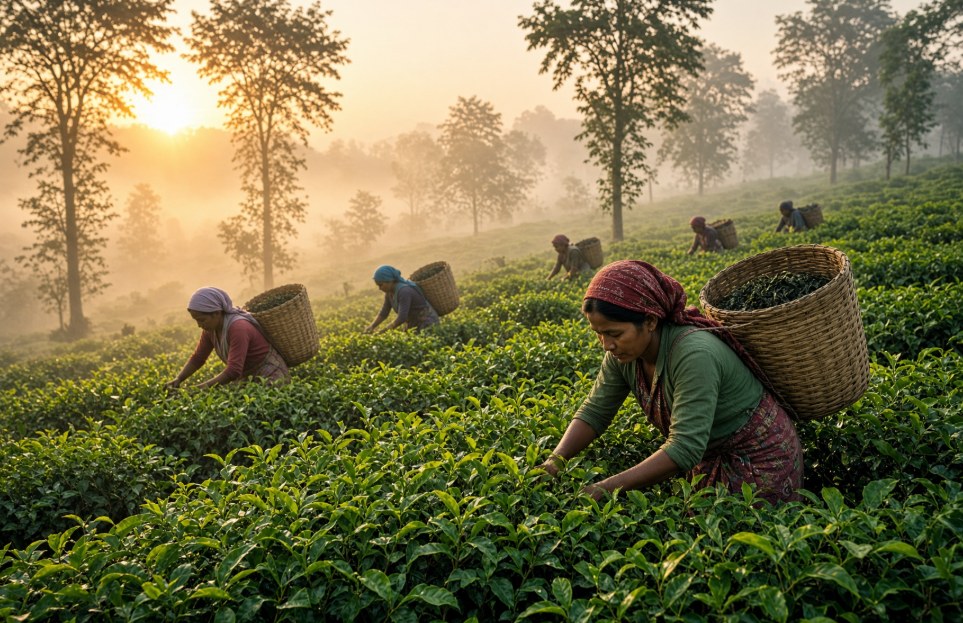
For coffee, the road ran through colonies. The Dutch East India Company established a coffee plantation on the island of Java in 1699. In 1714 the mayor of Amsterdam gave a young coffee tree to King Louis XIV of France, and in 1723 a French naval officer, Gabriel de Clieu, obtained a seedling from it and carried it to Martinique. A Portuguese officer, Francisco de Mello Palheta, sent to French Guiana in the eighteenth century, brought back the seeds that began coffee in Brazil. By 1788 France's colonies, above all Saint-Domingue, now Haiti, produced two-thirds of the world's coffee, and the people who grew it were enslaved Africans. In Brazil, coffee plantations relied on enslaved labour until Law No. 3353 of 13 May 1888 declared slavery abolished; a United States diplomat reporting from Brazil that year noted that the coffee crop was "exceptionally large".
For tea, the British carried production to India and Ceylon, now Sri Lanka. In May 1838 the first Indian tea from Assam was sent to England, and twelve chests were sold at auction in London that year, according to the Indian Tea Association. In 1867 James Taylor planted 19 acres of tea at the Loolecondera estate in Ceylon, according to the Sri Lanka Tea Board, and by the late 1880s almost all of the island's coffee plantations had been turned over to tea. About 800 tea estates operate in Assam now.
A mountain of small farms
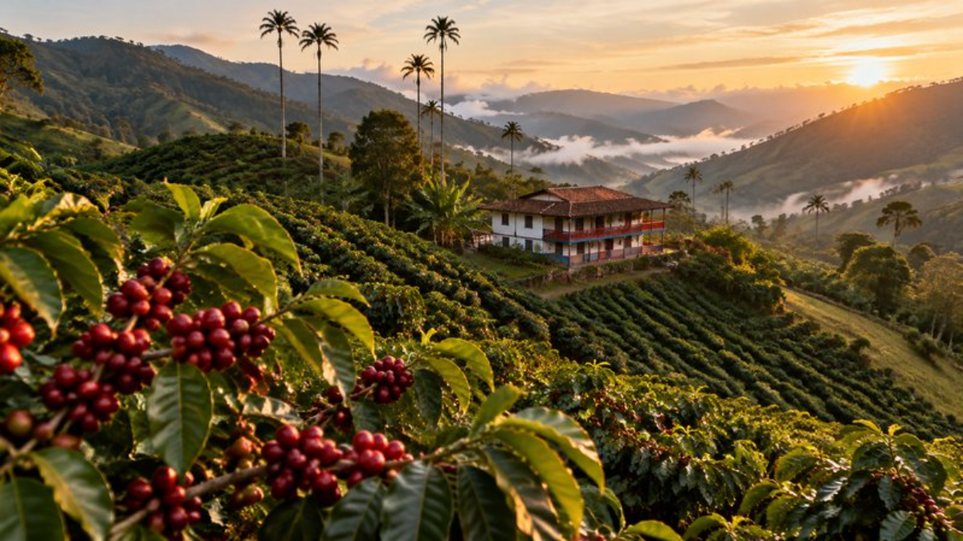
Coffee came to Colombia in the eighteenth century, carried, by one account, by Jesuit priests, and the first recorded exports left through the customs office at Cúcuta, near the border with Venezuela, in 1835, as the National Federation of Coffee Growers of Colombia records in its history of Café de Colombia. By 1850 coffee had spread to Cundinamarca, Antioquia and Caldas, and by the end of the nineteenth century the country's output had grown from about 60,000 bags to more than 600,000.
What grew from there was built on hillsides, by families. The Federación Nacional de Cafeteros de Colombia, the National Federation of Coffee Growers of Colombia, was born on 27 June 1927, as the Federation's own history of its first 89 years records, and the date is now celebrated as National Coffee Day. In 1940 the National Coffee Fund was created, an account of public coffee resources that the Federation administers under delegation from the national government. Today the Federation counts more than 340,000 federated coffee growers, organised in 383 municipal committees across 17 coffee-growing departments. In 1938 it founded the National Coffee Research Centre (Cenicafé), which bred the Castillo variety to resist diseases such as coffee rust, and in 1959 it created Juan Valdez, the coffee farmer who stands for coffee grown in Colombia, and opened a Café de Colombia office in Tokyo.
The way the coffee is grown shapes the way it tastes. The specification for Café de Colombia, registered in the United Kingdom as a protected geographical indication, sets out the method. The coffee is washed arabica, grown between 400 and 2,500 metres above sea level on a little over 800,000 hectares of planted coffee, within a coffee-growing area of about 3.6 million hectares. Pickers choose ripe cherries by hand, one at a time, and may return to the same tree up to eight times in a season. The cherries are pulped, the sticky layer around each bean is removed by 14 to 18 hours of fermentation or by machine, and the beans are washed and then dried slowly, in the sun or at no more than 55°C. The same specification describes the cup that results: a clean taste, medium-to-high acidity and body, and a full, pronounced aroma.
In Colombia the everyday cup has its own name, the tinto: a small black coffee, often sweetened, bought from street vendors and made at home through a cloth filter, as the journalist Clare Wiley reported for VICE on 31 March 2017. In Bogotá the café Amor Perfecto, where Diego Fernando Campos, the national barista champion of 2014 and 2016, works, serves Colombia's own speciality coffees to Colombian customers.
The landscape itself is on the World Heritage List. In 2011 the United Nations Educational, Scientific and Cultural Organization (UNESCO) inscribed the Coffee Cultural Landscape of Colombia: six farming landscapes and 18 towns in the coffee-growing axis of Caldas, Quindío, Risaralda and Valle del Cauca, where generations of farming families have grown coffee on steep slopes and built houses with bahareque walls of cane and earth. The inscription names coffee as the most representative symbol of Colombian national culture.
The harvest changes with the weather. The Federation's figures, released on 9 October 2026 and reported by Vanguardia and Valora Analitik, show that Colombia produced about 12.65 million bags in the coffee year to 30 September 2026, 15 per cent fewer than the 14.87 million of the year before, and exported 11.78 million bags. The Federation's general manager, Germán Bahamón, named the climate, the productivity of the coffee trees and the profitability of growing families as the three things that will decide how much of the world's demand the country can meet.
The coffee of Colombia
Production and exports: National Federation of Coffee Growers of Colombia, reported by Valora Analitik, 9 October 2026. Producers: the federation. Land, altitude and picking: the Café de Colombia specification.
From cherry to cup
- PickRipe cherries chosen by hand, one at a time
- PulpThe skin and fruit are taken off the bean
- Ferment14 to 18 hours to remove the sticky layer
- WashThe beans are washed clean
- DrySlowly, in the sun or at up to 55°C, to 10–12 per cent moisture
- CupClean taste, medium-to-high acidity and body, full aroma
How Café de Colombia tastes
The words are those of the Café de Colombia specification. The gold band shows the range it names.
Colombia, in dates
- 1700sCoffee reaches Colombia
- 1835First recorded exports, through Cúcuta
- 27 June 1927Colombia's coffee growers found their national federation
- 1938Cenicafé research centre founded
- 1940National Coffee Fund created
- 1959Juan Valdez campaign begins
- 2011UNESCO inscribes the Coffee Cultural Landscape of Colombia
- 202612.65 million bags in the coffee year to 30 September
The scale of the cup today
The United States Department of Agriculture's coffee circular of July 2026 forecasts world coffee production in 2026/27 at a record 189.7 million 60-kilogram bags and world consumption at a record 179.7 million bags. Brazil leads production at 71.9 million bags, followed by Vietnam at 32.5 million, Colombia at 13.4 million and Ethiopia at 12.1 million. Colombia is third in the world. The forecast of 13.4 million bags for 2026/27 is higher than the 12.65 million bags the Colombian federation counted for the coffee year just ended, although the two figures come from different agencies and cover slightly different periods. Ethiopia, where the plant is thought to have grown wild, is the fourth-largest producer in that forecast.
For tea, the Food and Agriculture Organization of the United Nations estimates world production at about 7.3 million tonnes in 2025. In Sri Lanka, the Ministry of Industry's tea sector overview, drawing on Central Bank of Sri Lanka reports, records about 200,000 hectares under tea and 231.867 million kilograms produced in 2022.
What fairness costs
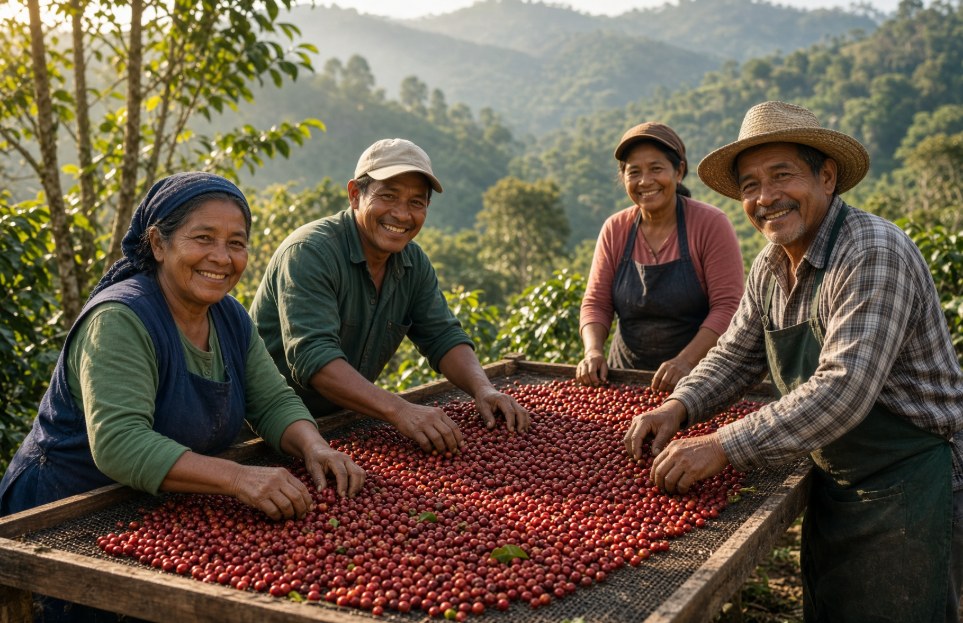
By the end of the twentieth century a further question was being asked about both drinks, which was who is paid what for growing them. The Max Havelaar Foundation, named after a novel by Eduard Douwes Dekker (writing as Multatuli) about labour on Indonesian plantations under colonial rule, was founded in the Netherlands in May 1988. Its first labelled coffee reached supermarkets on 15 November 1988, and the idea grew from contacts between the development organisation Solidaridad and the Union of Indigenous Communities of the Isthmus Region (UCIRI), a coffee cooperative in Oaxaca, Mexico. Under Fairtrade, a buyer pays at least an agreed minimum price and adds a premium on top.
The figures keep changing. On 30 July 2026 Fairtrade International announced new minimum prices that take effect on 1 December 2026: US$2.00 a pound for washed arabica, up 20 cents (11 per cent) from US$1.80, and US$1.30 a pound for natural robusta, up 10 cents. The Fairtrade Premium stays at 20 cents a pound and the organic differential at 40 cents a pound. Fairtrade International reported that cooperatives earned more than €57 million in Fairtrade Premium in 2024, and that the new prices rest on cost-of-production data from 57 cooperatives in 13 countries and feedback from more than 600 people in a consultation.
For tea, Fairtrade International states that about 800 estates operate in Assam and that roughly 1 per cent of them hold Fairtrade certification, and that certified estates in India sell around 10 per cent of their tea on Fairtrade terms, and it notes that the workers on these estates are employed on low cash wages.
Two sensible people at one table
The Latte Factor and its answer in the spending records look like a disagreement, and they can be set side by side as two ways of reasoning that each begin from something true.
The first begins with the sum. The 1,825 a year is 152.08 a month, and The Money Shelf shows how a monthly sum behaves when it is left alone for decades. Calculated for this essay with the book's own method, at a net return of 7 per cent a year with no rise in the sum and no allowance for inflation, 152.08 a month grows to about 399,190 over 40 years and about 185,537 over 30 years. At 4 per cent the 40-year figure is about 179,757. A person who reasons this way is right that a small sum saved for a long time is not small, and that the first ten years do a disproportionate share of the work, which is the finding of Claim 1 in the book.
The second begins with the cup. A person who stops at a café for ten minutes, or sits down to a pot of tea in the afternoon, is keeping a ritual with a long history: tea has been drunk in Japan since the ninth century, London has had coffeehouses since 1652, and in Colombia a tinto is bought from a street vendor. The case made for this way of living is that a day with some enjoyment in it is a day in which a person feels better and works better, and that this in turn helps a family. That is an argument about wellbeing, and the official records the book uses do not measure it, so the book does not rule on it. The book says that the cup is a small share of the budget, and that the larger sums are in housing and transport. The publishers' descriptions of I Will Teach You to Be Rich by Ramit Sethi and Pound Foolish by Helaine Olen make a related point, that a person can keep the latte and still automate the saving, and that cutting small expenses will not offset the largest ones.
The two ways of reasoning answer different questions: one asks what a sum becomes, and the other asks what a day is for. A person can hold both questions and answer them differently in different seasons of life.
The cup, the cake and the sum
The sum is 1,825 a year, and the records say it is the smaller part of the budget. From 1 December 2026 the Fairtrade minimum for washed arabica is US$2.00 a pound, the floor under the price a cooperative is paid for the same cherry. What the cup is worth beyond the sum has been argued in coffeehouses since the sixteenth century, and the argument has never needed an official record to carry on. On a hillside in Caldas or Quindío, the same cup begins with one ripe cherry, chosen by hand.
The cup in the budget
Share of average household spending: the daily 5 against housing and transport together. Sources are in the essay and in chapter 2 of The Money Shelf. The three countries measure different things, so they are not ranked against each other.
Who grows the coffee
Forecast production, 2026/27, million 60-kilogram bags. United States Department of Agriculture coffee circular, July 2026.
A fairer price, from 1 December 2026
Fairtrade International, announced 30 July 2026.
Coffee and Fairtrade, in dates
- 1400sCoffee grown in Yemen
- 1511Coffee established in Mecca
- 1652First London coffeehouse
- 1688Lloyd's Coffee House first named in London
- 1888Brazil abolishes slavery
- 1927Colombia's coffee growers found their national federation
- 2011UNESCO inscribes the Coffee Cultural Landscape of Colombia
- 1988First Fairtrade label, 15 November
- 2026Fairtrade minimum for washed arabica rises to US$2.00 a pound on 1 December
Tea, in dates
- 141 BCETea buried with Emperor Jing of Han
- Early 800sTea seeds reach Japan
- 1557Portuguese port at Macau
- 1662Tea reaches the English court
- 1838First Assam tea sold in London
- 1867James Taylor plants tea in Ceylon
Illustrations are AI-assisted.